
Last Updated: 2026-11-12
- Load cell types are named by body shape and load path. Single point for platform scales, shear beam for floor and hopper scales, double-ended shear beam and column for truck scales, S-type for tension and hanging loads, spoke for low-height high-capacity points.
- The 10–25 t range is covered by four types. Choose there by how the load is introduced (self-centring, rocking, rod-end) rather than by capacity.
- IP rating can change with capacity inside one family. Our SB shear beam is IP67 at 500 kg but IP68 from 1 t to 25 t; the S01 S-type is IP67 up to 1 t and IP68 at 2–5 t. Single point cells are IP65.
- Rated output is not universal: 2.0 mV/V for shear beams and columns, 3.0 mV/V for double-ended shear beams, 4.0 mV/V for spoke cells. Replacing one type with another changes the indicator span.
- Watch the units. Double-ended shear beam and spoke datasheets in our range are in klb; 50 klb is about 22.7 t, not 50 t.
Quick Answer: What Are the Types of Load Cells?
Load cells are grouped two ways: by how they sense force and by the shape of the metal body that carries the load. For industrial weighing, the sensing method is almost always a strain gauge bridge bonded to a steel or aluminium spring element. The practical choice is between body shapes, and each shape suits one kind of load path:
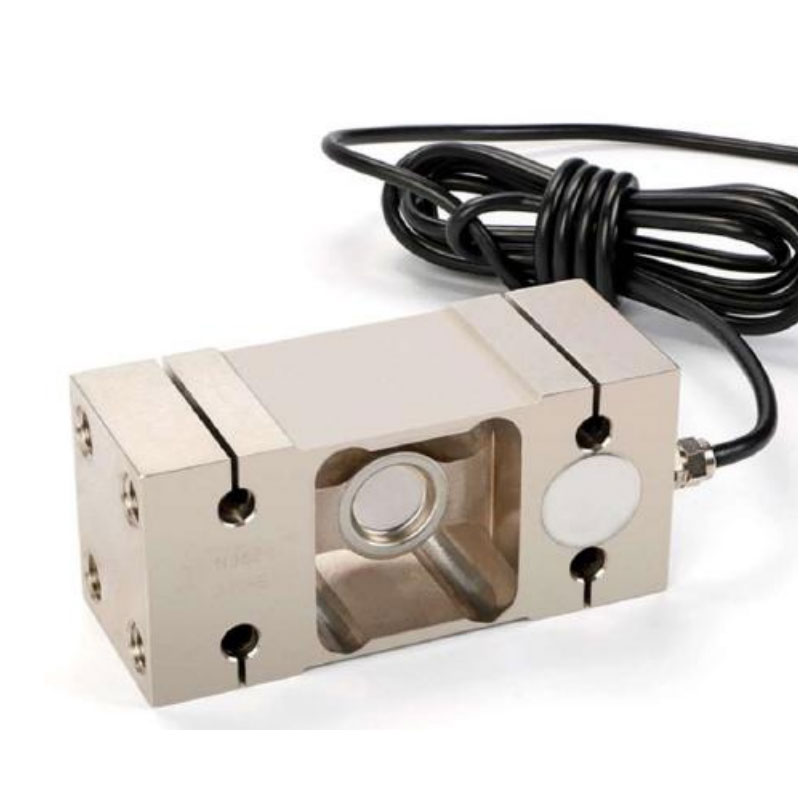
- Single point — one cell under a bench or platform scale, tolerant of off-centre loads.
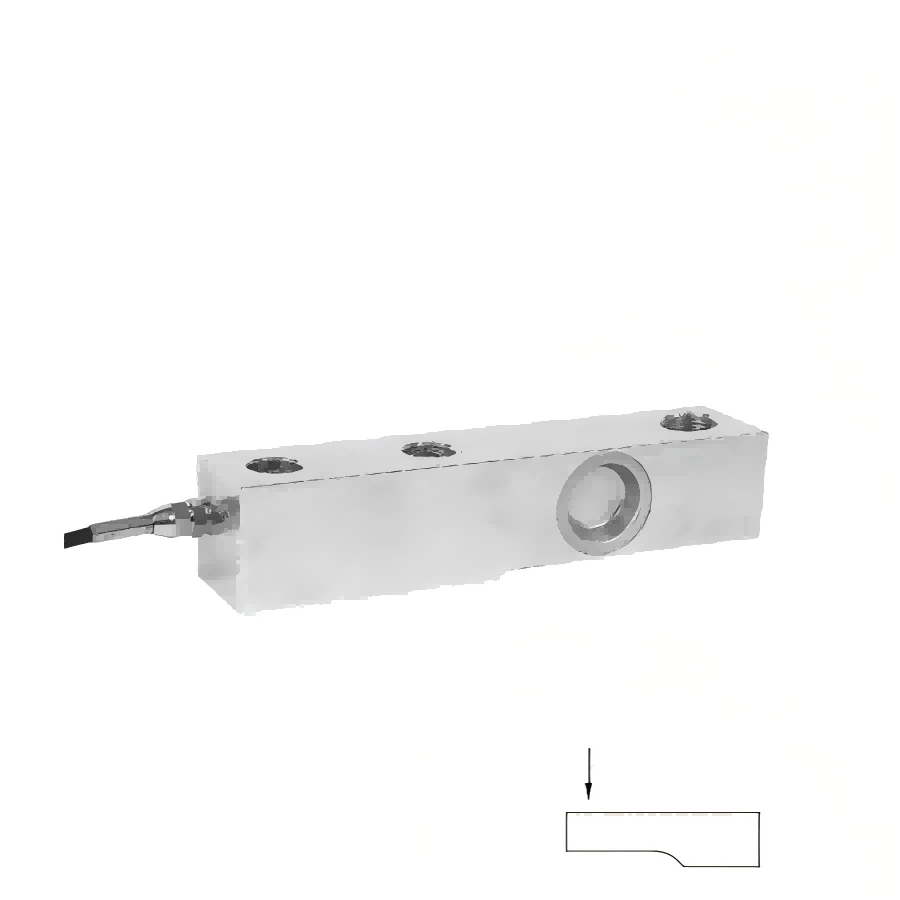
- Shear beam (single-ended) — bolted at one end, loaded at the other; floor, hopper and tank scales.
- Double-ended shear beam — supported at both ends, loaded in the middle; truck and livestock scales.
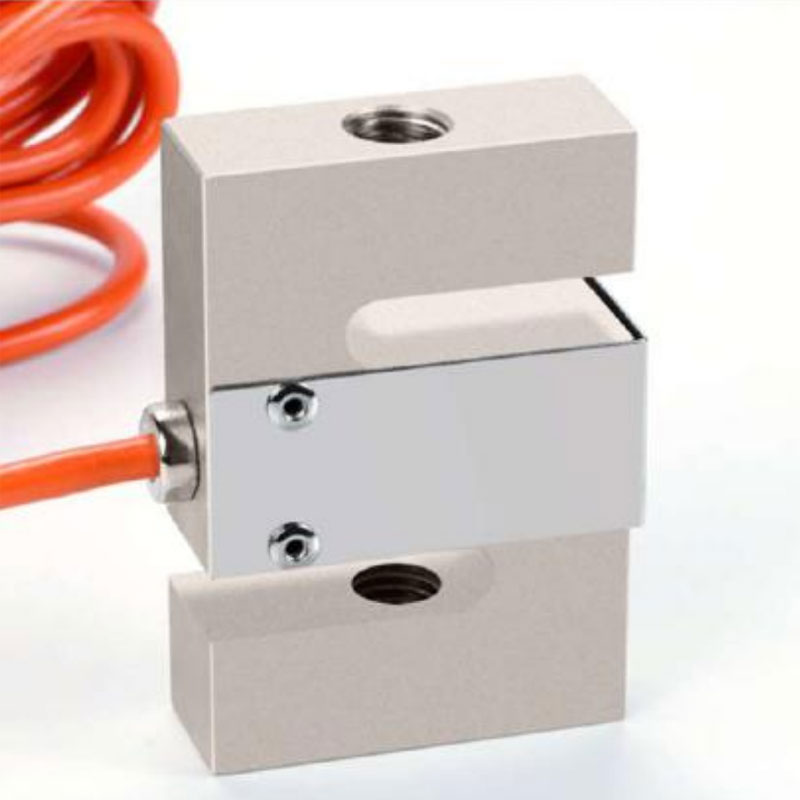
- S-type — threaded at both ends, tension or compression along its axis; crane scales, hanging hoppers, test rigs.
- Column / canister — compact, very high capacity in compression; truck, rail and silo weighing.
- Spoke / pancake — low height, high capacity, loaded through the centre hub; axle scales and testing machines.
- Compression disk, bellow and button — small-footprint compression cells for low-height or low-capacity points.
- Digital load cells — any of the shapes above with built-in electronics and an RS485 output.
The table below maps each type to its typical capacity range, protection class and applications, using the specifications of the models in our load cell catalog.
Load Cell Types Compared
| Type | Load direction | Capacity (our range) | Protection | Typical applications | Example model |
|---|---|---|---|---|---|
| Single point | Compression, off-centre tolerant | 250–1,000 kg | IP65 | Bench, platform, packaging and retail scales | XS01 |
| Shear beam (single-ended) | Compression | 0.5–25 t | IP67 (500 kg), IP68 (1–25 t) | Floor, platform, hopper and blending scales | SB01 |
| Low-profile shear beam | Compression | 0.5–25 t | IP67 (500 kg), IP68 (1–25 t) | Low-height floor scales, pallet scales | SQB01 |
| Double-ended shear beam | Compression, centre-loaded | 10–75 klb (≈4.5–34 t) | IP68 | Truck, axle and warehouse scales | QS01 |
| S-type | Tension and compression | 0.1–5 t | IP67 (0.1–1 t), IP68 (2–5 t) | Crane scales, hanging hoppers, belt scales, test rigs | S01 |
| Column / canister | Compression | 10–50 t | IP68 | Truck, railway, axle and silo scales | ZS01 |
| Spoke (pancake) | Compression through hub | 5–100 klb (≈2.3–45 t) | IP67 | Axle scales, warehouse scales, testing machines | LFS01 |
| Bellow | Tension and compression | 10–1,000 kg | IP68 | Small hoppers, belt scales, batching | HSX01 |
| Compression disk | Compression | By model | IP67 | Low-height compression points, presses | YBS01 |
| Digital (RS485) | Column, shear beam or DESB body | 10–40 t | IP68 | Truck, railway and hopper scales | ZS03-D |
Ranges are the standard capacities listed on each product’s datasheet; other capacities may be available on request.
Three Things the Type Name Does Not Tell You
Most load cell type guides stop at “shear beam for floor scales, S-type for tension”. When you specify or replace cells, three details on the datasheet matter as much as the type itself.
1. Protection class can change with capacity
Within one family, the smallest capacities are often built with a different sealing method from the larger ones. In our catalog the SB shear beam series is rated IP67 at 500 kg and IP68 from 1 t to 25 t, and the S01 S-type is IP67 from 0.1 t to 1 t and IP68 at 2–5 t. If your drawing calls for “IP68 S-type, 500 kg”, that combination does not exist in this series: you either accept IP67 or step up to a 2 t cell and lose resolution. The single point cells are IP65 with a −20 to +50 °C operating range, which is fine for indoor bench scales but not for washdown or outdoor use. Check the protection class against the exact capacity, not against the family name.
2. Rated output (mV/V) differs between types
A strain gauge load cell’s output is specified in millivolts per volt of excitation at full capacity. Our shear beams, columns, bellow and compression disk cells are 2.0 mV/V, the QS double-ended shear beams are 3.0 mV/V, and the LFS spoke cells are 4.0 mV/V. Replace a 3.0 mV/V cell with a 2.0 mV/V cell of the same capacity and the indicator will read about one third low until the scale is recalibrated. The tolerance also matters: the shear beams are trimmed to ±0.002 mV/V (0.1%), so cells in a four-corner scale can be swapped with little corner adjustment, while single point cells are specified at 2.0 ± 0.2 mV/V because each scale uses one cell and is calibrated as a unit.
3. Capacity units are mixed
Double-ended shear beam and spoke cells are traditionally specified in US units. Our QS series is listed at 10, 20, 25, 40, 50, 60 and 75 klb, and the LFS spoke series at 5 to 100 klb, while shear beam, S-type and column cells are listed in tonnes. 50 klb is about 22.7 t, not 50 t. An RFQ that simply says “50” for a truck scale cell can be quoted as either, so always write the unit.
Types of Load Cells by Sensing Technology
Before the body shapes, a short word on sensing principles, because “load cell types” is also used in this sense:
- Strain gauge — foil gauges bonded to a machined spring element form a Wheatstone bridge whose output changes with strain. This is the standard for industrial and trade weighing because it is accurate, stable and inexpensive. Every model in our catalog is a strain gauge cell, which is why their datasheets list rated output in mV/V and an excitation voltage of 5–12 V DC.
- Hydraulic — the load presses a piston against a fluid, and a pressure gauge or pressure transmitter reads the fluid pressure. Hydraulic cells need no electrical power at the cell, so they are used at remote sites and in hazardous areas.
- Pneumatic — similar in principle but using air pressure; used where cleanliness or intrinsic safety matters more than accuracy.
- Piezoelectric — a crystal generates charge when it is deformed. Good for dynamic forces and impact, not for static weighing because the charge leaks away.
- Capacitive — force changes the gap between two plates. Used in some compact force sensors and consumer products.
The rest of this guide covers strain gauge load cells by shape.
Single Point Load Cells
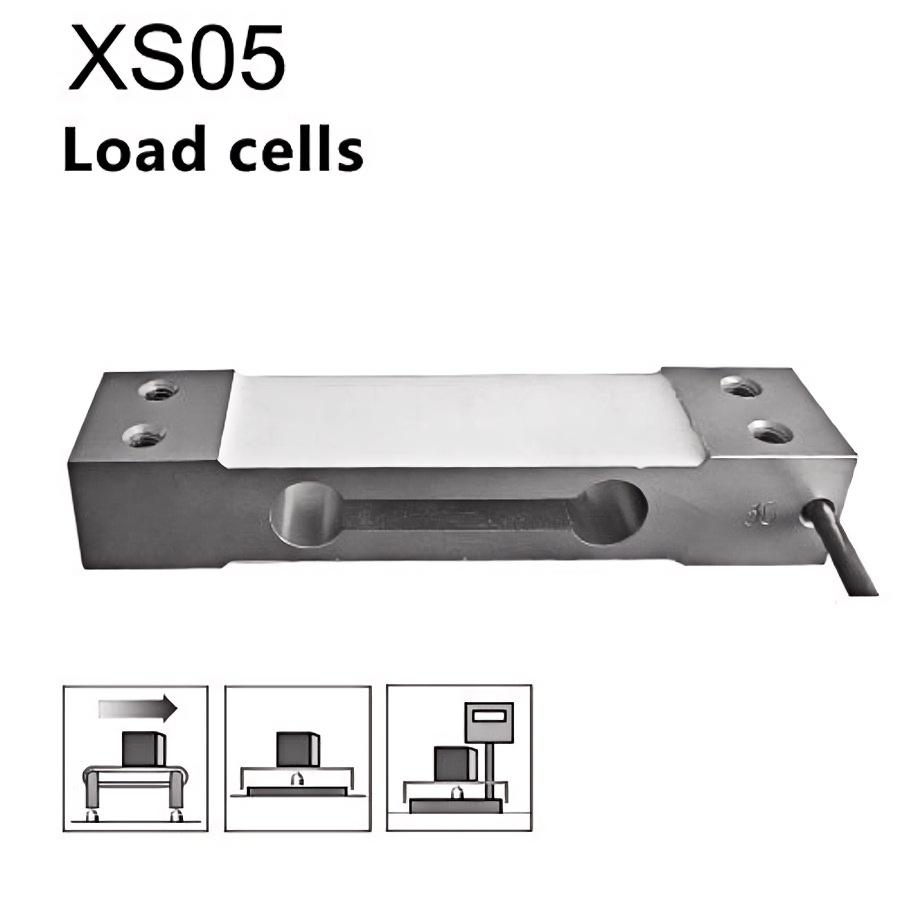
A single point load cell (also called a platform or off-centre load cell) is a block, usually aluminium or alloy steel, with a double-bending beam machined through it. It is designed so that the reading stays the same wherever the load sits on a platform of the rated size. That lets a bench, counter, checkweigher or packaging scale use one cell instead of four.
- Capacity: our XS series covers 250, 300, 500 and 1,000 kg; smaller aluminium cells are common for retail scales.
- Specify: maximum platform size, capacity, accuracy class, cable length.
- Watch: do not exceed the rated platform size; corner errors grow quickly beyond it.
Shear Beam Load Cells
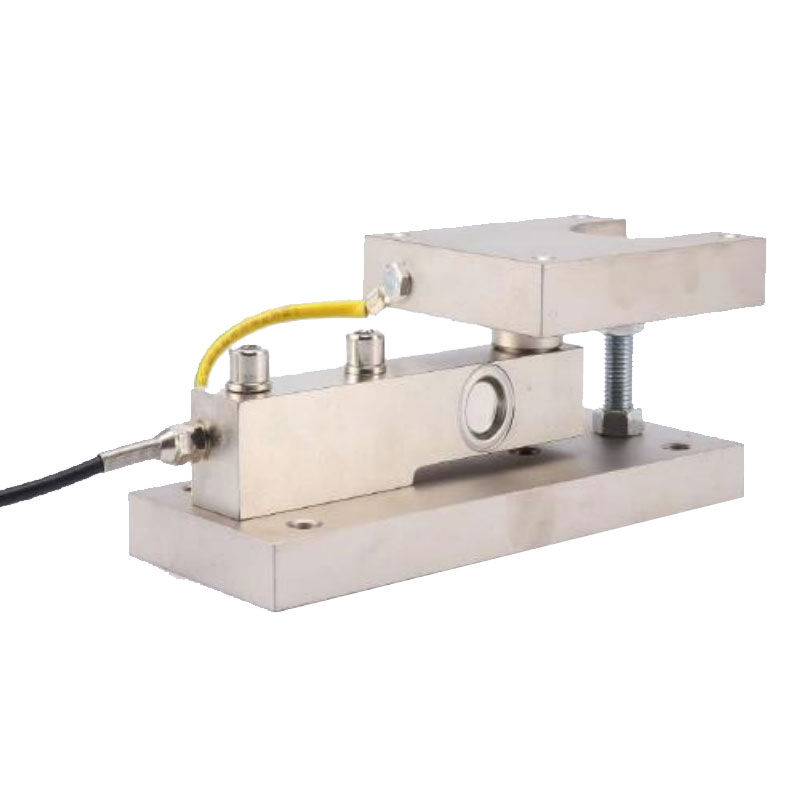
The single-ended shear beam is the workhorse of industrial weighing. One end is bolted to the base, the load is applied at the other end through a ball, rocker foot or mounting assembly, and the gauges measure shear strain in a web near the neutral axis. Measuring shear rather than bending makes the output less sensitive to where exactly the load is applied.
- Capacity: 0.5 t to 25 t in our SB series; the SQB low-profile versions cover the same range for scales where height is limited.
- Applications: four-cell floor scales, pallet scales, hoppers, blending and batching scales, tank weighing.
- Accuracy: OIML R60 C2 or C3 class.
- Tip: for tanks and hoppers, use a weighing module (cell plus mounting hardware) to handle thermal expansion and side loads.
Double-Ended Shear Beam Load Cells
A double-ended shear beam is supported at both ends and loaded at the centre, often through a link or ball that lets the platform move slightly without side-loading the cell. This makes it tolerant of the thermal movement and braking forces of a vehicle scale.
- Capacity: our QS series is listed at 10–75 klb (about 4.5–34 t).
- Accuracy: OIML R60 D1 or C2 class on the QS datasheet.
- Applications: truck scales, axle and wheel scales, livestock and warehouse scales.
S-Type Load Cells
The S-type (or S-beam) is named for its shape. Load is applied through threaded holes at the top and bottom along the cell’s axis, so it measures both tension and compression. It is the default choice when the load hangs from the cell.
- Capacity: 0.1 t to 5 t in our S01–S04 series.
- Applications: crane and hanging scales, suspended hoppers, belt tension, material testing, retrofitting mechanical scales.
- Tip: use rod-end bearings at both ends so bending and twisting are not transmitted into the cell.
Column (Canister) Load Cells
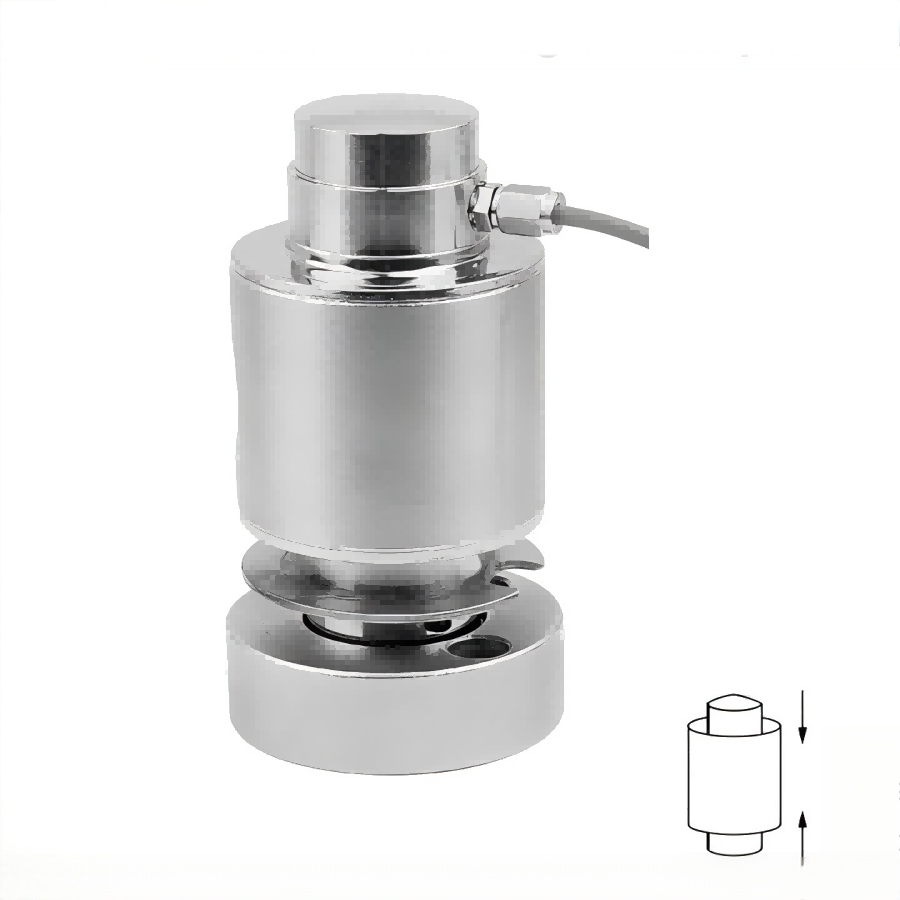
A column load cell is a short steel column with gauges around its waist. It packs very high capacity into a small footprint and works in compression. Rocker-column designs are self-centring: after the platform moves, it returns to centre without side loads.
- Capacity: 10, 15, 20, 30, 40 and 50 t in our ZS series.
- Applications: truck and railway scales, axle scales, large silos and floor scales.
Spoke, Compression Disk, Bellow and Button Load Cells
- Spoke (pancake) cells look like a wheel: an outer ring bolted down, a centre hub that takes the load, and gauges on the spokes. They are low and stiff, with high capacity. Our LFS series runs from 5 to 100 klb and is used in axle scales, warehouse scales and testing machines.
- Compression disk cells are short, round compression cells for points where height is limited. Our YBS series is rated IP67 with 2.0 mV/V output.
- Bellow cells use a sealed bellows-shaped body and suit low capacities. The HSX series covers 10–1,000 kg at IP68 for small hoppers, belt scales and batching.
- Button (miniature) cells are very small compression cells for fixtures and tight spaces; they are usually custom items.
Digital Load Cells
A digital load cell has the amplifier and analog-to-digital converter inside the cell and outputs a digital signal instead of mV/V. Each cell can report its own reading and status, which makes it easier to find a faulty cell in a multi-cell truck scale and removes the analog junction box trimming step.
Our ZS03-D digital column, QS05-D digital double-ended shear beam and SB01-D digital shear beam cover 10–40 t with an RS485 4-wire output and IP68 protection. If you are choosing between analog and digital outputs for a wider system, our 4-20mA vs RS485 Modbus vs HART guide explains the trade-offs.
How to Choose a Load Cell Type: 5 Steps
- Define the load path. Does the load sit on the cell (compression), hang from it (tension), or both? Is it on one point (single point) or several (corners, legs)? This picks the family.
- Calculate capacity per cell. (Maximum live load + dead load) ÷ number of cells × safety factor. About 1.25 is a common factor for static loads; use more where there is impact, vibration, wind or uneven loading. Round up to the next standard capacity, but do not oversize far, because resolution is a fraction of capacity.
- Choose how the load is introduced. In the 10–25 t range a shear beam, double-ended shear beam, column or spoke cell can all carry the load. Pick the one whose mounting handles your movement: rocker columns and link-mounted double-ended beams for vehicle scales, weighing modules for tanks, rod ends for S-types.
- Match the environment. Check the protection class at your capacity (see above), material (alloy steel with plating for dry indoor use, stainless steel for washdown and corrosive areas), temperature range and cable length.
- Set the accuracy class and output. C2 or C3 for most industrial and trade scales; if the scale is legal-for-trade, ask for the OIML or NTEP certificate covering the exact model and capacity. Choose analog (mV/V into an indicator or transmitter) or digital (RS485) to match your indicator.
What do C2 and C3 mean?
OIML R60 accuracy classes use a letter for the class and a number for the maximum number of verification intervals in thousands. C3 allows up to 3,000 intervals, C2 up to 2,000, and D1 up to 1,000. A 30 t truck scale divided into 3,000 intervals of 10 kg needs cells of at least C3 class.
Sourcing Notes: MOQ, Lead Time and What to Send
SIBXSUN supplies load cells from partner production lines in China and also sources KELI and ZEMIC brand load cells for buyers who specify those brands.
- MOQ: 1 piece for most standard models (flexible).
- Lead time: 2–3 days for in-stock items; 15–30 days for custom capacity, cable length or output.
- Samples: available, with freight on the buyer’s account.
- Terms: FOB Ningbo or CIF; T/T, PayPal or Western Union; 12-month warranty.
To quote quickly, send: scale or application type, live and dead load, number of support points, preferred type (if any), accuracy class, environment and IP requirement, cable length, analog or digital output, and quantity. For a full supplier checklist, see our load cell sourcing guide.
Related Guides
- Load cell manufacturer China: complete sourcing guide
- KELI load cell: complete buyer’s guide
- 4-20mA vs RS485 Modbus vs HART: choosing sensor output signals
Frequently Asked Questions
What are the main types of load cells?
By sensing principle, almost all industrial weighing load cells are strain gauge types; hydraulic, pneumatic, piezoelectric and capacitive cells are niche. By shape, the common types are single point, shear beam, double-ended shear beam, S-type, column, spoke, compression disk, bellow and digital load cells.
Which load cell type is best for a platform scale?
Use one single point cell for a bench or platform scale within the cell’s rated platform size. Use four shear beam cells for a larger floor scale, and double-ended shear beam or column cells for truck scales above roughly 20–30 t per support point.
What is the difference between a shear beam and an S-type load cell?
A shear beam is bolted at one end and loaded in compression at the other, for floor scales, tanks and hoppers. An S-type is threaded at both ends and measures tension or compression along its axis, for hanging loads, crane scales and test rigs. In our range, shear beams run 0.5–25 t and S-types 0.1–5 t.
How do I calculate the load cell capacity I need?
(Live load + dead load) ÷ number of cells × safety factor (about 1.25 for static loads, more with impact or vibration), then round up to the next standard capacity. A 2,000 kg hopper holding 3,000 kg on three cells needs (5,000 ÷ 3) × 1.25 ≈ 2,083 kg per cell, so a 3 t cell.
What do C2 and C3 mean on a load cell datasheet?
They are OIML R60 accuracy classes: C2 allows up to 2,000 verification intervals and C3 up to 3,000. For legal-for-trade scales, ask for the OIML or NTEP certificate covering the exact model and capacity.
Specifying load cells for a new scale or replacing old ones? Browse our load cells and weighing sensors or send your scale type, capacity, number of cells and environment and we will reply with a matched model, datasheet and FOB Ningbo quotation.